Introduction
For home fragrance brands, seasonal retailers and mixed wellness gift sets that pair candles with other ritual products. The central buyer question is simple: Which product and packaging choices must be locked before a private-label candle can be quoted responsibly? The useful answer is rarely a catalogue item or a single MOQ. It is a controlled decision path that connects product application, customer expectations, factory testing, retail packaging and shipment inspection.
At DaoHalo, we work from an 8,000 m² Shenzhen facility supporting B2B product development and export preparation for Eastern-inspired wellness, gift and ritual collections. A clear brief lets our production team test the details that matter before an order is released: whether components fit, whether the packaging closes correctly, and whether the finished carton reflects the approved sample.
Start With the Intended Customer Experience
Before comparing prices, describe the customer moment the product is meant to support. A buyer should be able to explain where the item is used, what the customer receives, how it is opened, and which details make the experience feel complete. That description gives the supplier a practical basis for recommending an established structure or a more developed route.
For private label candle wholesale, a useful brief separates non-negotiables from preferences. Non-negotiables may include the product format, retail positioning, destination market or delivery date. Preferences may include colour direction, surface texture or optional gift-card ideas. This distinction helps a factory identify decisions that affect feasibility rather than treating every mood-board detail as a fixed production requirement.
For a view of our Shenzhen factory capability, product categories and customisation process, explore the linked pages before you finalise an RFQ.
Build a Specification That a Factory Can Repeat
Good sourcing documents are concise but specific. They do not need to be technical drawings for every project, yet they should give the supplier enough information to quote the same item you intend to approve. Include the following points in the request and update them after sampling:
- vessel material, size, lid and visible finish
- fragrance direction and sample-approval process
- label dimensions, artwork and warning space
- retail box, breakage protection and export-carton plan
Ask the supplier to state its assumptions beside the quotation. This protects both sides when an item is still exploratory. For example, a quotation for a stock component with a branded sleeve is not comparable to a quotation for a custom component in a rigid printed box, even if the product category sounds the same. Splitting product, packaging, assembly and one-time development costs also makes later decisions more transparent.
Use Samples as a Decision Tool
A physical sample is not only a sales sample. It is the first version of the quality reference. Review the complete retail unit: the product, all accessories, labels, inserts, closure and outer protection. If there is a use interaction, carry it out. If the product is intended as a set, open it as a customer would and then pack it again as a warehouse team would.
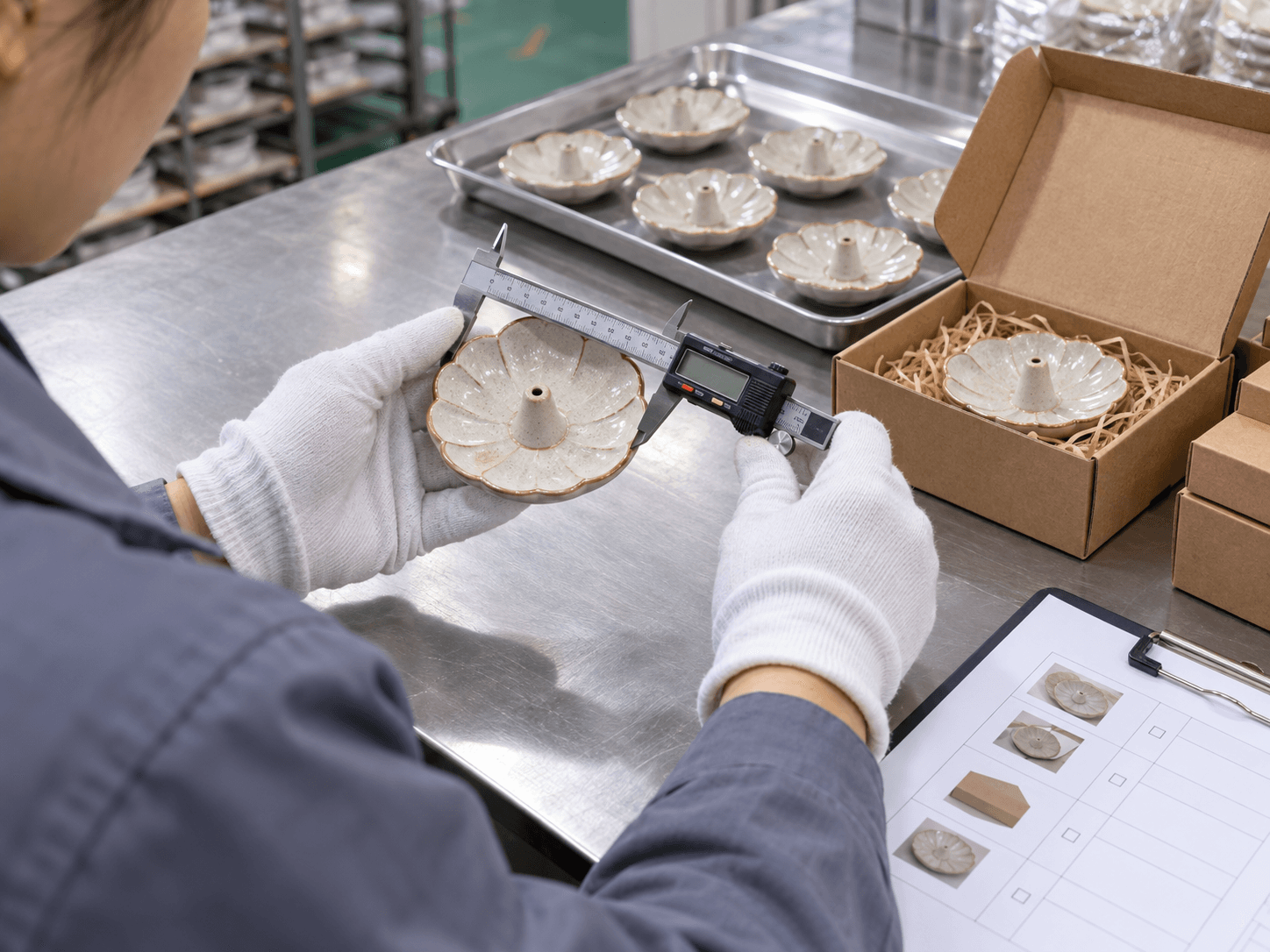
During sample review, record approved photos, version numbers, dimensions and unresolved points in writing. This record should travel into the production file. It supports factory testing because the team has something more dependable than a verbal description of what the buyer liked. It also supports a later shipment inspection because the finished goods can be checked against the same reference.
Practical sample-approval checkpoints
- Review the complete visual system, not only the fragrance sample.
- Confirm label placement and adhesion on the actual vessel finish.
- Assess the retail pack for movement around the vessel and lid.
- Use a shipment inspection checklist that covers product, label, pack and carton count.
Mid-Project Checkpoint: Turn the Brief Into a Sample Plan
Before moving from a promising sample to bulk production, bring the buyer, product team and factory contact back to the same document. Confirm the product version, component list, artwork revision, sample observations and any customer requirements that still need a decision. This is also the right point to ask whether the existing packing route still fits the final item, rather than assuming a packaging idea from the first quotation will work unchanged.
If you are comparing options, send your requirements with the target market, expected quantity and delivery window. A focused review can identify which details need a physical sample and which can remain flexible until the production plan is confirmed.
Plan Quality Control Before Production Starts
Quality control is most useful when it is designed into the workflow. For a simple product, the important points may be count, appearance, label version and carton quantity. For a mixed gift set, they can also include component identity, fit, assembly sequence and protective packing. State the points that are critical to your customer and distinguish them from minor cosmetic variation that may be normal for the selected material.
An in-process review can reveal an assembly or print issue while correction is still practical. A final shipment inspection can then confirm finished goods, retail packs and export cartons against the written plan. Neither replaces a clear specification. The stronger the approved sample and inspection checklist, the more meaningful the result will be.
Packaging and Shipment Preparation
Packaging has two jobs: present the product at retail and protect it on the route. They are related but not interchangeable. A thin retail carton may give an excellent shelf appearance while relying on an insert and master carton for transport protection. At installation preparation or pack-out review, check component movement, edge contact, closure and carton count using the actual production configuration.
Before freight handoff, confirm the goods-ready quantity, SKU mix, outer-carton marks and document requirements with the parties responsible for shipping. Destination requirements and commercial terms vary, so the buyer should obtain relevant logistics and compliance guidance for the specific order. For market-specific product obligations, confirm the final requirements with a qualified adviser and the relevant authority. For EU consumer-product context, buyers can start with the European Commission product safety information.
Risks to Resolve Early
- A label can look right in artwork but distort or lift on a curved or textured vessel.
- Fragrance and colour expectations need a controlled sample reference.
- Glass or ceramic vessels require protection that is designed for the freight route.
Resolving these points early does not make a project over-engineered. It gives the buyer a cleaner basis for comparing supplier options and gives the factory a fair chance to make the same product consistently. Clear customer requirements are usually the shortest path to fewer sample rounds and less avoidable rework.
FAQ
Can I start with a stock candle vessel?
Often, yes. It can reduce development variables while leaving room for branded label and packaging choices.
What should be approved in a candle sample?
Vessel, lid, label, fragrance direction, outer pack and protective packing should be reviewed together.
Can candles be included in gift sets?
Yes, provided the kit design controls weight, breakage risk, labelling and component movement.
Conclusion
The best B2B sourcing decisions connect the product idea to its real conditions of use, packing and delivery. Define the product clearly, approve a complete sample, convert that approval into a factory-ready specification, and use it again during shipment inspection. This process is more dependable than chasing a low opening quote, and it creates a stronger basis for repeat orders.
CTA: Discuss Your Product Brief
Need help translating an idea into a supplier-ready request? Send your requirements with your target market, product format, estimated quantity, packaging direction and delivery window. DaoHalo's Shenzhen team can review a practical route for sampling, assembly and export preparation.