
Introduction
A wellness gift set is not simply several products in a larger box. It is a single retail experience made from multiple components that must fit, travel and arrive in the condition your customer expects. This makes custom gift-set sourcing different from buying individual SKUs. The buyer has to make choices about assortment, unboxing sequence, insert design, pack weight, carton protection, labelling and final assembly before the order is ready for production.
For brands, concept retailers, corporate-gifting teams and wellness businesses, a well-built set can create a higher perceived value and a stronger reason to purchase. The risk is that an attractive concept becomes expensive or fragile because too many components, poorly defined packaging or late changes make it difficult to assemble and ship consistently. This guide gives wholesale buyers a practical planning route from concept to shipment inspection.
What makes a wellness gift set commercially useful?
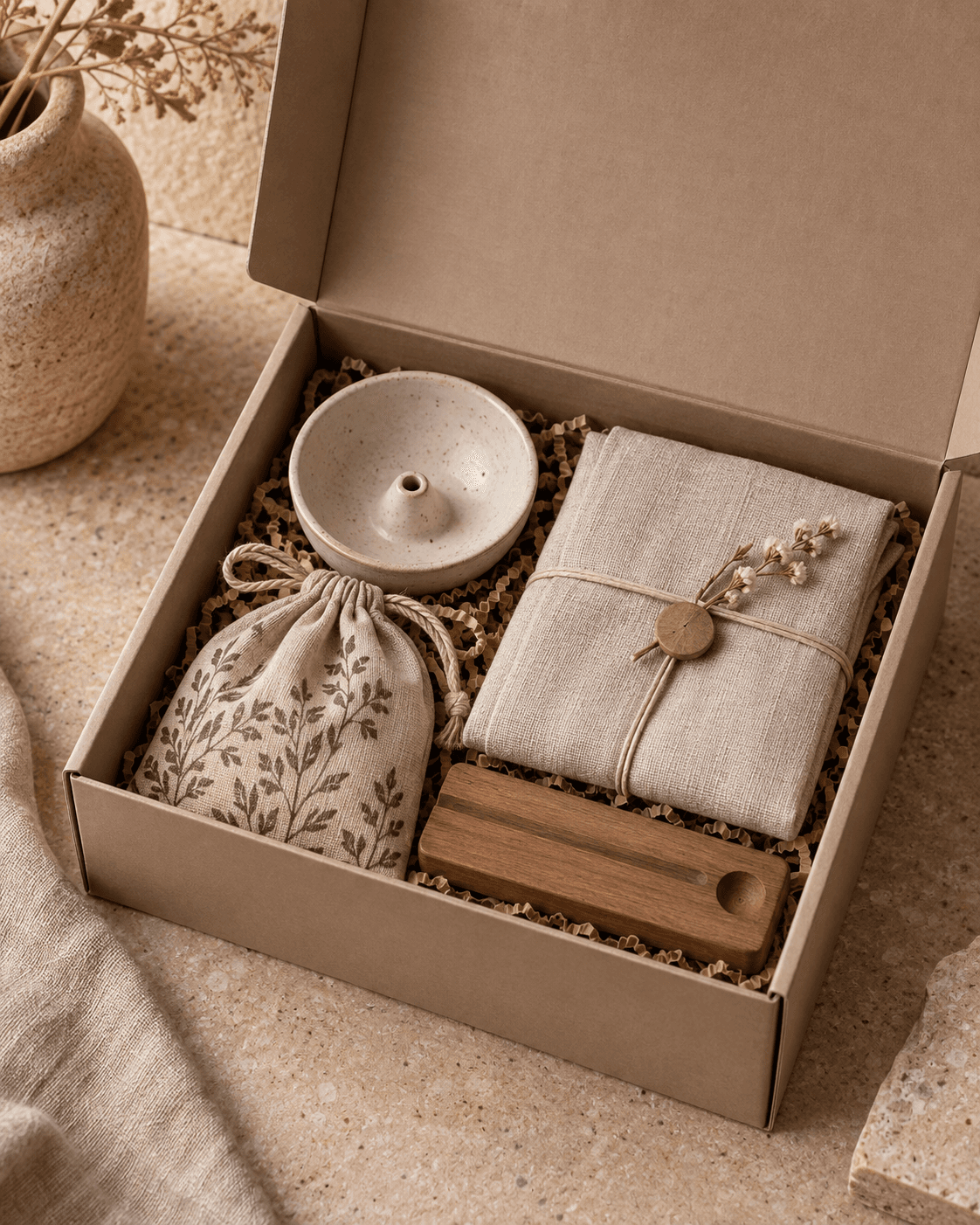
A commercially useful wellness gift set has a clear use occasion, a controlled component count and an appropriate price architecture. It should feel complete without becoming confusing or hard to replenish. In many cases, two to five complementary items are enough: for example, incense with a holder and a ritual card; a candle with a ceramic vessel and a small accessory; or a tea and self-care set with a defined presentation purpose.
The best combination is not necessarily the most expensive one. It is the one that fits a customer’s moment of use, communicates the brand’s point of view and can be packed reliably at the planned quantity. Before asking for a quote, write a short sentence that explains the set’s purpose. “A quiet evening wind-down gift for concept retail” is more useful than “a premium spiritual box,” because it helps the supplier suggest relevant product components and packaging priorities.
Build the brief around a customer requirement
Custom gift-set projects are easier to quote when the buyer describes the commercial situation as well as the products. A factory team needs to know who will receive the set, where it will be sold, how it will be delivered and what constraints matter most.
Questions a supplier needs answered
- Who is the recipient? Consumer retail shoppers, corporate recipients, hotel guests, subscription customers or event attendees each need a different presentation and price point.
- What is the use occasion? Seasonal gifting, onboarding, relaxation, a retail launch or a recurring client programme influences product application and the message inside the box.
- What is the target market? The destination affects language, mandatory product information and the documents the buyer should prepare with their responsible person or compliance adviser.
- What is the target quantity and date? A gift set has several supply paths. State the delivery date, sales date and any hard event date so the quotation reflects realistic sampling and freight time.
- What is the cost priority? Be clear about whether the buyer is protecting a unit-cost target, a premium unboxing experience, a material claim or a tight launch deadline. These priorities can conflict, and the factory cannot resolve them well without direction.
At an 8,000m² Shenzhen factory, set assembly is easier to plan when the component list and packing order are visible from the start. The team can then consider whether products are sourced as finished units, whether an insert needs to separate fragile items and how the complete pack will move through inspection and carton packing.
Choose components that belong together
The simplest rule is that every component should either improve the use experience or strengthen the gift’s presentation. If a component does neither, it may add cost, breakage risk and assembly time without creating customer value.
A practical component framework
- Hero product: The item that defines the gift’s reason for being, such as incense, a candle, a tea set or a ceramic ritual object.
- Functional companion: An item that makes the hero product easier to use, such as a holder, tray, vessel or storage element.
- Tactile or narrative layer: A card, small textile detail, botanical element or printed guidance that helps the recipient understand the set.
- Packaging system: Outer box, insert, tissue, sleeve, closure and any shipping-protection elements.
Consider the full product application. If incense is included, determine whether the set includes an appropriate holder or whether the customer must already own one. If ceramics or brass items are included, confirm their position and protection in the box. If the set includes scented components, test whether their fragrance can affect neighbouring items or printed materials during storage.
How to control MOQ and cost without weakening the set
MOQ is shaped by the least flexible component, not simply by the number of gift boxes. Custom printed cartons, specialty finishes, custom inserts, fragrance variants and small accessory orders can all set the commercial minimum. A buyer can control risk by identifying what must be bespoke and what can use an existing, proven structure.
For a first order, it may be sensible to keep the hero product and final presentation distinctive while using standard-compatible internal components. Another approach is to develop one box structure across several seasonal colourways so that the physical format remains stable while the visual message changes.
Ask for the quote in components: products, outer box, insert, printing, assembly, export carton and one-time development items. This lets the buyer see the effect of adding a ribbon, a magnetic closure, a foam insert or a second scent. It also makes it easier to decide where a small cost increase genuinely improves the customer experience.
Packaging development: design for protection and assembly
Gift-set packaging has to do three jobs: present the brand, hold each item in the intended order and protect the complete set through distribution. The insert is not a decorative afterthought. It controls movement and can reduce the chance that products touch, scratch or break inside the box.
What to review in a packaging sample
- Finished exterior and internal dimensions
- Product position, removal sequence and visible presentation
- Insert material, cut-outs and tolerance around each component
- Closure strength and opening feel
- Weight and carton capacity
- Artwork version, barcode space and required consumer information
- Ability to close and pack the set consistently on the production line
Installation preparation is relevant even for a gift box. The factory needs a repeatable assembly sequence: which component is placed first, how it is protected, where the card is positioned and how the box is closed. If a worker needs to force a component into the insert or interpret an unclear visual reference, the design needs refinement before mass production.
Treat sample approval as a production decision
The sample is the point where a buyer should approve the final system, not only the individual products. A useful sample review includes the set as a customer sees it and as a factory packs it. Open the box, remove the products, check their fit, close it again and assess the external presentation after handling.
Create a written approval sheet with the product list, pack count, approved images, dimensions, packaging materials, artwork files and final comments. This gives the factory a clear reference for quality checks and protects the buyer if a late design request changes the cost or schedule.
Recommended quality checks
During in-process work, factory testing can focus on component count, insert fit, visible finish, packaging closure and the correct placement of cards or labels. Before shipment, the inspection can review selected finished sets and their master cartons for quantity, appearance, pack condition, carton markings and secure closure. The actual inspection method and acceptance criteria should be agreed in writing; a “standard QC” claim is not enough for a mixed-product set.
For fragile products, discuss a small packing trial or transport simulation before the full run. The purpose is not to promise zero damage in every logistics situation. It is to identify movement, weak corners or poorly supported items while the packaging can still be changed.
Plan export readiness early
Export preparation is often where a well-designed gift set reveals hidden complexity. The buyer needs a commercial invoice and packing details, while the products and packaging need the right identification, warnings and destination-market information where applicable. Exact requirements vary by country, product type and sales channel.
If the set will be sold to EU consumers online, the buyer should review the EU General Product Safety Regulation with a qualified adviser or responsible person. Article 19 requires targeted distance-sales offers to show clear manufacturer or responsible-person contact information, product identification and applicable warning/safety information. The official text is available through EUR-Lex. If candles are included for the US market, review relevant safety labelling guidance, including CPSC business guidance for candles. These links are planning references, not legal advice or a substitute for destination-specific review.
The supplier can support the product and packaging information it controls, but the importer/brand should confirm final market obligations, claims and translations. Build this check into your artwork approval date, not after cartons are printed.
A practical custom gift-set timeline
- Concept and budget alignment: Agree use occasion, target price, market, quantity and essential components.
- Component and packaging feasibility: Select product options, assess fragile-item protection and identify MOQ drivers.
- Sample development: Review the full assembled set, not only product swatches or individual items.
- Artwork and approval: Confirm dielines, product information, cards, barcode areas and packing instructions.
- Production and assembly: Use the approved component list and assembly sequence; conduct in-process checks.
- Shipment inspection and handoff: Review finished sets and carton packing against the signed standard before freight release.
The timeline varies with the set’s complexity and material availability. A buyer should avoid promising a retailer a launch date until the sample route, packaging development and inspection points are understood.
FAQ
How many products should a custom wellness gift set include?
There is no universal number, but two to five items is often enough to create a coherent experience without making the box difficult to assemble or protect. Start with one hero product and add only components that improve use or presentation.
What drives the MOQ for a custom gift box?
MOQ can be driven by the printed box, insert, decoration method, custom component, fragrance variant or required tooling. Ask the supplier to explain which item is setting the minimum and to separate one-time costs from recurring unit costs.
How do I protect ceramics or fragile items inside a gift set?
Use an insert and packing configuration designed around the actual finished items. Test the assembled pack for movement, closure and carton fit. A sample review and documented packing trial are more reliable than assuming a product photo proves the box is protective.
Who is responsible for compliance information on a gift set?
Responsibilities depend on the market, product type and supply arrangement. The brand/importer should confirm final legal obligations, labels and claims with a qualified adviser or responsible person. The supplier can provide relevant product and packaging information within its scope.
Conclusion
Custom wellness gift sets can create a compelling B2B product when the buyer treats them as a complete system: customer use, component selection, presentation, protection, assembly, inspection and export readiness. A focused brief, a fully assembled sample and a written quality plan help the factory turn a creative concept into a repeatable order.
CTA: Build an export-ready wellness gift set
Planning a retail, corporate or seasonal wellness gift programme? Get a quote by sharing your target market, intended contents, estimated quantity and desired delivery date. Our team can help you outline a practical component, packaging and shipment-preparation route.